A product case study by Eros Marcello, ex-Meta
CRUCIAL
Inner-Circle Social
This is the (Un)Social Network. A place for you and yours. Your Day Ones. Your ride or dies. From BFFs to GFs. We're making Social social again.
- A semi-autonomous agent inside every circle
- Hyper-personal; built for people you actually know
- Transparent, user-controlled intelligence
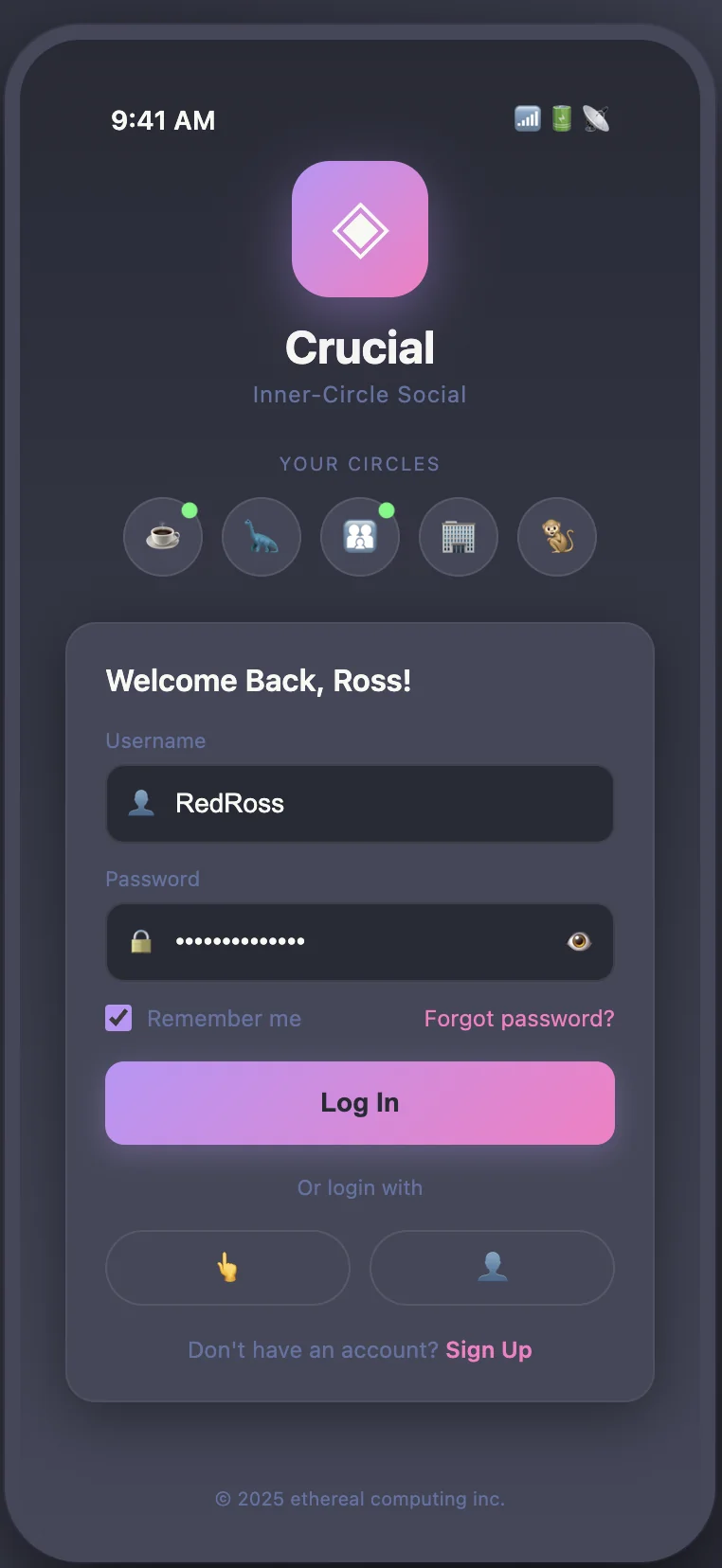
Working prototype below; iOS app up next
The Problem
We optimized the soul out of social
Engagement-maximizing feeds turned friendship into an audience business. Attention became the product, and the people who mattered most got lost in the scroll.
What social became
- Infinite scroll engineered to never let you leave
- Algorithmic feeds that reward outrage over closeness
- Follower counts standing in for friendship
- Notifications built to interrupt, not to inform
What it used to feel like
There was a time your profile had a song. A mood. A custom everything. Your friends list was a statement, not a follower count; the internet felt like a bedroom, not a billboard.
That era ended, but the need it served never did. People still want a small, loud, loyal corner of the internet that belongs to them and theirs.
The intimacy wave keeps proving the demand, and hitting the same wall
Cocoon
2019–2021A private home for your closest people. Built by ex-Facebook product minds, funded on a no-ads subscription. Beloved, then acqui-hired before escape velocity.
Path
2010–2018Capped your network at 50 friends because intimacy was the product. Beautiful, ahead of its time, and starved by its own restraint.
BeReal
2019–2024One honest photo a day, no filters, no chasing followers. Forty million people showed up. The habit didn’t hold.
Intimacy isn't a failed idea. It's an under-powered one.
Every private-social pioneer faced the same trade-off: the constraints that made it intimate were the constraints that kept it small; intimacy demanded constant effort from the very users it served. Crucial's bet is that agentic AI finally breaks the trade-off. Agents absorb the coordination work intimacy used to cost, and subscription economics mean no one ever has to sell your attention to keep the lights on.
The vision: an AI-native platform that amplifies genuine relationships while reducing screen time, born from the intimacy of the private-social wave, the authenticity of the era when profiles had souls, and lessons learned shipping AI at Meta scale.
Subscription-based
No ads. No attention market. You are the customer, never the product.
Privacy-first
Your data lives and dies inside your circles. Nothing leaks to a graph you can’t see.
AI-native
Semi-autonomous agents are the architecture, not a bolted-on feature.
The Product
Circles: 6–8 people.
That's the point.
Not an audience. Not a following. The handful of people you’d call at 3 AM, with an agent that works for the group.
The circle concept
Each Circle is capped at six to eight people: the size where group dynamics stay human, context stays rich, and trust is already established. Nobody performs for an algorithm because there is no algorithm to perform for.
A dedicated agent lives inside each circle. It learns the group's rhythms (who plans, who disappears, who needs a nudge) and handles the coordination friction that usually kills group chats, with the circle's full knowledge and consent.
Mood Rings
The circle’s collective emotional weather, rendered as a living gradient. Ambient awareness at a glance; no scrolling required.
Agent Actions
Contextual, permission-first suggestions: the reply worth sending, the plan worth making, the friend worth checking on.
Pulse Metrics
Relationship health instead of engagement stats. The only numbers that matter are the ones about staying close.
Circle Check-ins
Presence without performance. Know your people are good without anyone having to post about it.
Live Demo
Watch the agent read the room
A working group-chat prototype: six friends, one agent. This isn't a mock; it's live. Scroll it, tap the agent cards, vote in the poll.
Contextual interventions
Agent cards surface at exactly the right beat in the conversation: a suggested reply, a plan, a nudge; never as interruptions.
Mood ring
The animated ring up top is the group’s collective energy, read from the conversation and rendered as ambient color.
Proactive relationship support
Brunch schedules itself. Joey’s audition gets remembered. The agent handles the friction so the friends handle the friendship.
The cast is borrowed from a certain '90s coffee-shop sitcom, because a demo about closeness should star the most famous inner circle on television. Watch for the agent noticing Joey's audition and Ross's dinosaur corrections.
Adaptive Intelligence
From eight suggestions to the right two
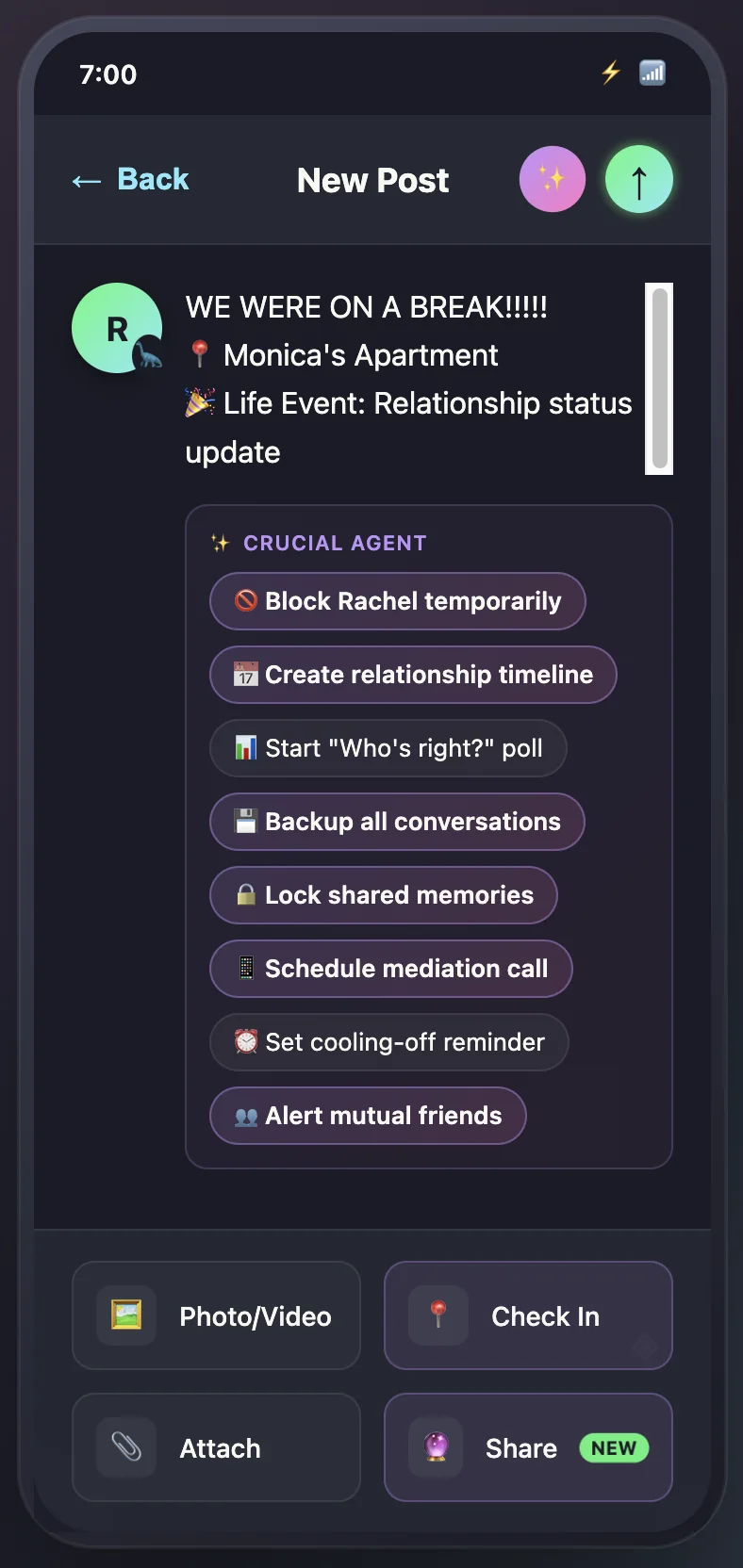
The scenario: a breakup detonates inside the circle. “WE WERE ON A BREAK!!!!!” The agent reads the moment and responds, then spends the next three months learning which responses actually help.
Adaptive learning progression
Initial response
The agent reads emotional context and relationship dynamics, then offers the full option space: protective, constructive, social, wellness.
8
suggestions shown
72%
relevance (design target)
The principle: the interface gets quieter as it gets smarter. Most AI products add surface area over time; Crucial is designed to shed it, shrinking decision fatigue with every interaction. Accuracy figures are design targets for the learning system, not measured outcomes.
System Design
The agent asks. It never assumes.
Three transparent phases, one binary contract with the user, and latency budgets grounded in classic HCI research.
Process
Ingest the conversation, tokenize, encode into semantic vectors with full context of the circle’s history and dynamics.
Triage
Decide whether to act at all; then route to the right model and tools based on context, urgency, and the user’s standing preferences.
Generate
Produce the suggestion, labeled and attributable, with the user holding the veto at every step.
Binary decision architecture
Every autonomous capability runs on the same contract: the agent proposes, the human disposes. Two buttons: yes or not now. No settings maze mid-conversation, no dark patterns, no silent action.
- Explicit consent before any autonomous action
- Plain-language reasoning attached to every suggestion
- Adjustable autonomy levels per circle
- Every dismissal teaches the agent what not to ask again
Coordination • Crucial Agent
Should I coordinate weekend plans for the group? I noticed everyone's been talking about wanting to meet up.
Marked as automated · reasoning available · reversible
~0.1s
Instantaneous
Feels immediate; no feedback needed
~1s
Maintains flow
Smooth experience; minimal feedback
10s+
Requires feedback
Progress indicators are essential
Latency budgets follow Jakob Nielsen's classic response-time limits; every agent interaction is designed against them.
Trust
Nothing hidden. Everything adjustable.
Most platforms bury their AI behind a black box. Crucial exposes every parameter, logs every action, and hands users the dials, because trust in an agent has to be verifiable, not vibes.
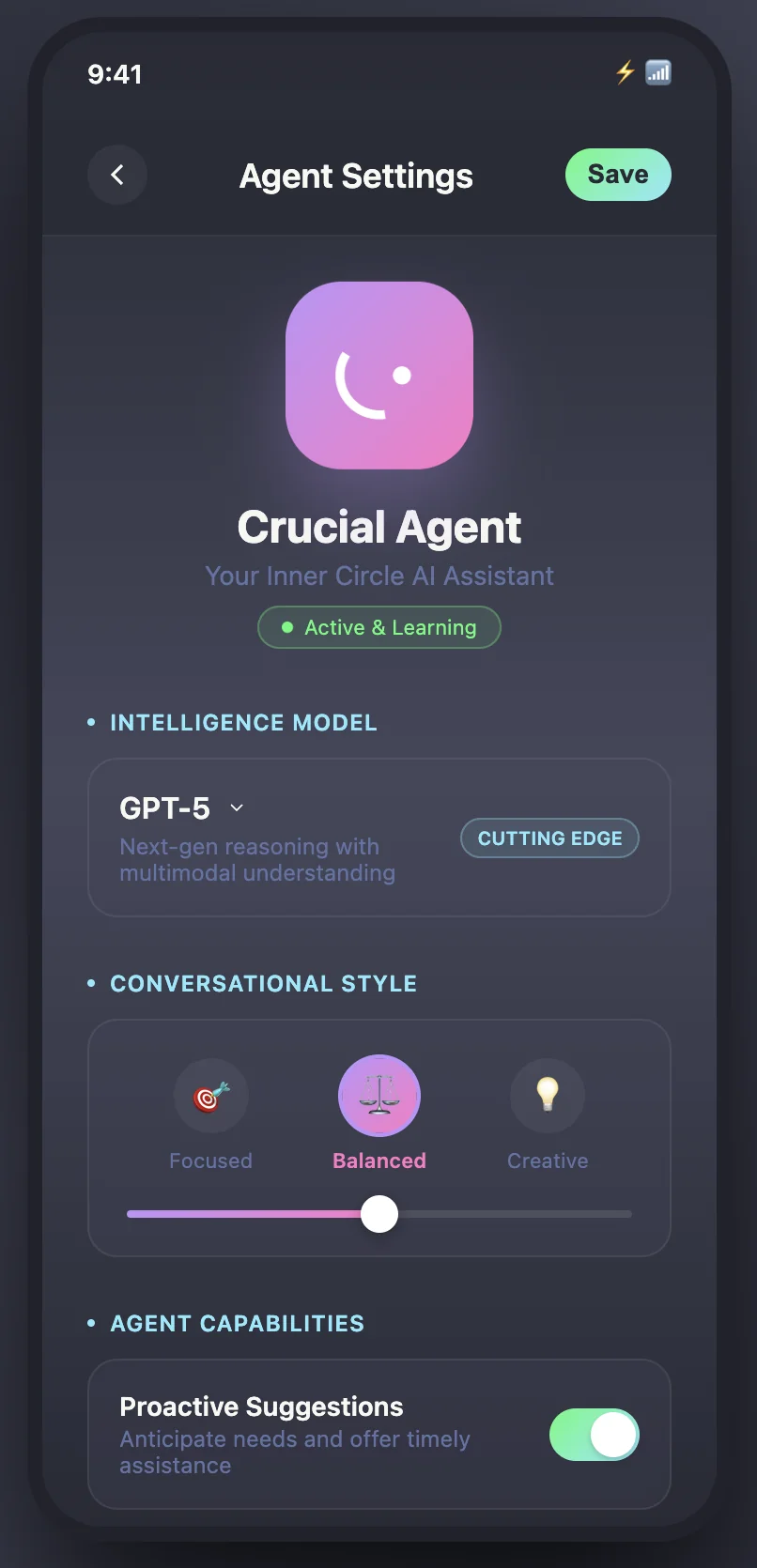
Granular agent configuration
Intelligence model selection
Users pick the model behind their agent, with plain-language descriptions of what each is good at. No hidden AI decisions, and no lock-in to any single provider.
Conversational style calibration
A slider from focused to creative sets the agent’s personality per circle. Your work circle’s agent and your day-ones’ agent shouldn’t sound the same.
Capability toggles
Proactive suggestions, intervention timing, contextual awareness: each ability is individually consentable.
Complete visibility
Every decision, parameter, and intervention is inspectable. No black boxes.
Granular control
Consent is per-capability, per-circle; never one big blanket toggle.
Reversible always
Any agent action can be undone; any permission can be walked back.
The Edge of the Roadmap
Two provocations
A case study should show where the thinking gets uncomfortable. These are the two features that start arguments, by design.
Decoy Mode
ExperimentalAn autonomous social presence for when you're unavailable. Your agent holds down basic interactions (acknowledging messages, keeping plans warm) while you're offline, heads-down, or healing.
The catch that makes it defensible: your circle always knows. Every decoy interaction is visibly marked as automated. It's a stand-in, never an impersonation.
Mind Control Interface
Highly experimentalBiometric-driven UI adaptation: the interface responds to your emotional state and cognitive load in real time. Stressed? The UI simplifies itself. Locked in? Complexity unlocks.
Low: UI remains full-featured
High: complex interactions enabled
Simulated readouts: a concept exploration of adaptive-interface design, not a shipped sensor stack.
The ethics framework that gates both
The Profile
A profile with a pulse
If you grew up on the version of the internet where your page was your bedroom wall (a song, a mood, a look that was unmistakably yours), you already know why this matters. Crucial brings identity back, then gives it a heartbeat.
A profile with a song
Now Playing is a first-class field. What you’re listening to is part of who you are, the way it used to be.
Mood and status, front and center
Not a story that expires; a state your people can actually see. Ambient, honest, yours.
A pulse, not a feed
Steps, circle strength, live location; shared only inside the circle, rendered as presence instead of posts.
Gradient identity
Every member gets a gradient signature of their own. Instant recognition, personal expression, zero templates.
Every pixel works a double shift: the profile is simultaneously identity, presence, and the agent's context source. That density is what lets the rest of the app stay quiet.
Craft
Dark ambient, human touches
A cyberpunk-warm visual system tuned for late-night closeness, plus human-factors decisions that treat attention as something to protect, not extract.
Color system
Purple
Primary actions & brand
Pink
Highlights & emotional accents
Cyan
Links & interactive elements
Green
AI presence & success states
A developer-culture dark palette on #1a1b26; easy on the eyes at 1 AM, which is when inner circles are actually talking.
Type & identity
Poppins
Display: headlines with warmth and weight
Inter
Body: engineered for long-form legibility
Source Code Pro
Data: parameters, logs, and the agent's receipts
Each member's gradient signature threads through avatars, rings, and highlights; the system stays coherent while letting identity stay loud.
Anti-addiction by design
No infinite scroll. No public metrics. No algorithmic feed. The app has nothing to maximize except how quickly you can get back to your life.
Notification as UX
Rich notifications carry full context (who, what, what the agent proposes), so the answer can happen from the lock screen. Screen time drops; awareness doesn’t.
“Marked as automated”
Every agent-generated action wears a visible label. Disclosure is the trust primitive the whole system is built on.
Process
From concept to code, AI-native
The way this case study was made is part of the argument it’s making.
Conceptual marination
Non-linear exploration across social dynamics, agent capabilities, and the psychology of small groups, all before a single pixel.
Tool-centric iteration
Rapid prototyping with Claude, Cursor, v0, and Figma. Concepts validated in hours as working artifacts, not static comps.
Recursive refinement
Each build cycle fed the next: the chat demo sharpened the agent patterns, the agent patterns reshaped the profile.
Cross-disciplinary synthesis
UX craft, applied AI, and social psychology folded into one product argument instead of three separate documents.
The stack
Practicing what it preaches
This case study was designed and built in human-AI collaboration: the same pattern Crucial productizes. Human creative direction, agentic execution, recursive review. Concept to working interactive prototype in days, not quarters.
That speed isn't a party trick. It's the capital math of AI-native product development: small team, short loop, working software as the pitch.
The Thesis
Don't scale the circles.
Scale the number of circles.
The answer to “can intimate social ever be big?” has been hiding in plain sight.
Every circle stays small. The platform doesn't. Millions of intimate spaces instead of one infinite feed: families, day-ones, group chats that deserved better, and above all artists and the small rooms where their real fans live. The unit of growth is the circle, not the follower.
The feed business is solved, saturated, and running out of trust. The opposite bet is wide open: a network of inner circles where AI works for the relationships instead of the engagement graph: coordination, memory, presence. Subscription economics keep every incentive clean, and agents finally make intimacy scalable, because the effort that small-group closeness used to demand is exactly the work agents are best at absorbing.
And here's the quiet part said out loud: somewhere out there, a legendary social graph is waiting for its second act. Whoever wakes it up shouldn't rebuild a feed. They should hand every artist a constellation of circles, give every profile back its song, and let agents carry the weight that killed every private-social pioneer before this moment. That's not a nostalgia play; it's a capital-light, AI-native product bet with a built-in why-now.
This page is the blueprint. I've been building toward it my whole career: shipping AI experiences to billions at Meta, then designing the product those capabilities finally make possible. The iOS prototype is next; I'm not waiting for permission.
If you're reading this and it sounds familiar, you know where to find me.
Ready when you are.
Product, prototype, and conviction: assembled and warm. Twenty minutes is all this needs.